
Lilith in art
Lilith in Art: From Ancient Demon to Modern Archetype
Few female figures have inspired as much fascination, controversy, and artistic interpretation as Lilith. Across thousands of years, she has appeared as demon, goddess, temptress, rebel, outcast, witch, lover, and symbol of feminine power. Her image has continuously evolved, reflecting the fears, desires, beliefs, and social values of the cultures that imagined her.
More than a mythological character, Lilith has become an enduring archetype that continues to inspire artists, writers, psychologists, and spiritual seekers around the world.
The Origins of the Legend
The origins of Lilith can be traced back to ancient Mesopotamian mythology, where references appear to female night spirits associated with wilderness, sexuality, and untamed forces of nature. Although scholars continue to debate the precise connection between these early figures and the later Lilith of Jewish tradition, many historians see them as part of the same mythological lineage.
Lilith became more widely known through Jewish folklore, particularly in medieval texts such as the Alphabet of Ben Sira, where she appears as Adam's first wife. According to the legend, Lilith refused to submit to Adam and chose exile rather than obedience. She left the Garden of Eden and became a symbol of independence, freedom, and rebellion against imposed authority.
This narrative would later become one of the most powerful foundations of her artistic and symbolic legacy.
An Archetype Beyond Mythology
The enduring fascination with Lilith can be partly understood through the work of Swiss psychiatrist Carl Gustav Jung, whose theory of archetypes suggests that certain symbolic figures emerge repeatedly across cultures because they express universal aspects of the human psyche.
Lilith can be interpreted as an archetype of the untamed feminine: independent, instinctive, creative, sensual, and unwilling to conform. She represents aspects of the psyche that societies have often feared, suppressed, or misunderstood.
Psychiatrist and author Jean Shinoda Bolen explored similar themes through mythological feminine archetypes, helping modern readers understand how ancient stories continue to shape personal identity, relationships, and psychological development.
Through this perspective, Lilith becomes more than a legendary figure. She becomes a mirror reflecting hidden dimensions of human nature.
Lilith in Symbolist and Pre-Raphaelite Art
During the nineteenth century, Lilith became particularly popular among Symbolist and Pre-Raphaelite artists, who were fascinated by themes of beauty, desire, temptation, mystery, and the unconscious mind.
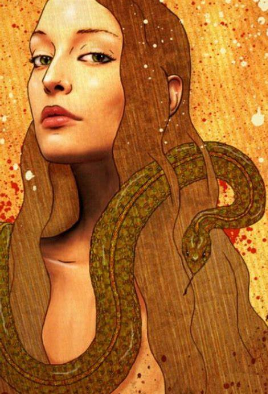
One of the most celebrated representations is Lilith by John Collier. In this painting, Lilith appears as an enchanting and dangerous figure, her long flowing hair intertwined with a serpent. She embodies both attraction and threat, beauty and power, reflecting Victorian anxieties about female independence and sexuality.
The serpent, a recurring symbol in Lilith imagery, connects her to ancient themes of wisdom, temptation, transformation, and forbidden knowledge.
The Modern Reinvention of Lilith
By the twentieth century, artists increasingly began to reinterpret Lilith not as a demon but as a symbol of female autonomy and empowerment.
Many modern artists viewed her refusal to submit not as a moral failing but as an act of courage. In this new interpretation, Lilith became a figure of liberation, self-determination, and authenticity.
Artists associated with feminist movements embraced her as a powerful counterpoint to traditional portrayals of women. Her image evolved from feared outcast to icon of personal freedom.
Works by artists such as Judy Chicago and Monica Sjöö contributed to this transformation, presenting Lilith as a creative force rather than a destructive one.
Lilith as a Contemporary Symbol
Today, Lilith continues to inspire artists working in painting, sculpture, literature, film, fantasy art, and digital media.
Her symbolism remains remarkably adaptable. Depending on the artist's perspective, she may represent:
feminine independence
sexuality and desire
personal freedom
rebellion against social expectations
intuition and instinct
transformation and self-discovery
the integration of the shadow self
This flexibility helps explain why Lilith remains relevant in contemporary culture. Every generation finds new meaning within her story.
The Eternal Mystery of Lilith
Perhaps the greatest reason for Lilith's artistic longevity is that she refuses to fit neatly into any category. She is neither entirely dark nor entirely light.
Neither villain nor heroine. Neither demon nor goddess. She exists in the space between opposites, where mystery thrives and imagination flourishes.
For artists, this ambiguity is irresistible.
For viewers, it invites endless interpretation.
And for centuries, that enduring mystery has ensured that Lilith continues to captivate the human imagination.