
Lilith and Samael
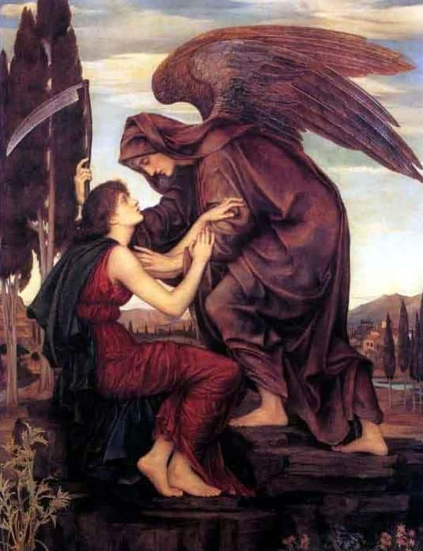
Lilith and Samael: The Union of Rebellion and Shadow
Among the many figures that inhabit the landscapes of mythology, mysticism, and esoteric tradition, few are as fascinating as Lilith and Samael. Their names have inspired centuries of stories, religious interpretations, artistic representations, and psychological reflections. Together they form one of the most powerful and enigmatic symbolic pairings in Western esoteric tradition.
The Exile of Lilith
According to later Jewish folklore, Lilith was Adam's first wife. Unlike Eve, who was created from Adam's rib, Lilith was said to have been created from the same earth as Adam and therefore considered herself his equal.
Conflict arose when Adam expected obedience and submission. Refusing to accept a subordinate role, Lilith chose exile over compliance. She left the Garden of Eden and ventured into the unknown, becoming one of the most controversial and misunderstood figures in mythological history.
Over the centuries, religious traditions transformed her into a night demon, a seductress, a dangerous spirit, and a symbol of chaos. Yet modern interpretations often view her very differently: as a symbol of freedom, self-determination, and the refusal to surrender one's identity.
The Enigmatic Samael
Samael is an equally complex figure.
Depending on the source, he appears as an angel, an accuser, a destroyer, a tempter, a guardian of divine justice, or a demonic prince. His name has often been translated as "Venom of God" or "Poison of God," reflecting his ambiguous role within mystical traditions.
Unlike purely evil figures found in later folklore, Samael frequently occupies a paradoxical position. He is both adversary and servant, destroyer and revealer, shadow and teacher.
In many mystical traditions, Samael represents the forces that challenge human beings to confront uncomfortable truths, limitations, and hidden aspects of themselves.
The Meeting of Two Outsiders
Later Kabbalistic traditions describe Lilith and Samael as companions and counterparts.
Whether interpreted literally, symbolically, or psychologically, their union is deeply meaningful.
Both exist outside conventional order.
Both reject imposed limitations.
Both embody forces that established structures seek to control or suppress.
Together they form a symbolic partnership representing independence, knowledge, instinct, desire, power, and transformation.
In mythological terms, they become rulers of the shadow realms. In psychological terms, they can be understood as representations of aspects of the human psyche that society has historically feared, rejected, or misunderstood.
A Jungian Perspective
From the perspective of Carl Gustav Jung, myths often express archetypal forces operating within the collective unconscious.
Lilith may be viewed as an archetype of the untamed feminine: instinctive, independent, sensual, creative, and unwilling to submit.
Samael may be interpreted as an embodiment of the shadow, representing hidden knowledge, confrontation, transformation, and the disruptive forces that challenge personal growth.
Their union symbolizes the encounter between freedom and shadow, instinct and awareness, desire and transformation.
Rather than being simply "evil" figures, they can be understood as symbols of psychological energies that seek integration and understanding.
Lilith and Samael in Art and Esotericism
Throughout the nineteenth and twentieth centuries, artists, writers, occultists, and psychologists increasingly reinterpreted Lilith and Samael.
Rather than seeing them as monsters, many began viewing them as symbols of individuality, rebellion against oppression, hidden wisdom, and personal transformation.
This shift reflects a broader cultural change: a growing interest in understanding the shadow rather than merely condemning it.
In literature, visual art, and modern spiritual traditions, the pair continues to inspire exploration of themes such as freedom, power, temptation, identity, sexuality, and self-discovery.
The Enduring Symbolism
The lasting fascination of Lilith and Samael lies in their ambiguity.
They are neither entirely dark nor entirely light.
Neither heroes nor villains.
They inhabit the threshold between order and chaos, obedience and freedom, creation and destruction.
Perhaps this is why their story continues to resonate.
At a symbolic level, Lilith and Samael remind us that growth often begins where certainty ends, and that some of the most transformative forces in human life emerge not from comfort, but from confrontation with the unknown.
More than mythological beings, they remain enduring symbols of the mysteries that lie within the human soul.